
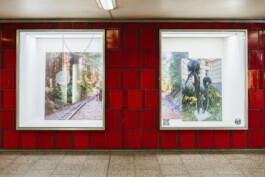
Stand by Me ist eine Ausstellung von Elmar Hermann (*1978) bei Island of Contemporary Art in Köln. Im Rahmen der Vorbereitungen für die Show hat sich eine dialogische Aufarbeitung angeboten.
ICA: Deine eigene Arbeitsweise als Künstler ist durchzogen von Kollaborationen, ephemeren Momenten und dem Verschwimmen von Autorengrenzen. Was hat dich dazu bewogen und wie passt das zu deinem Kunstverständnis?
ELMAR: Für mich ist Kunst in erster Linie eine Form von Kommunikation. Wir nutzen Bilder, Sprache und Situationen, um uns mit anderen Menschen auszutauschen. Dabei fasziniert mich, wie vielfältig diese Kommunikation sein kann – sie kann humorvoll, konflikthaft, verbindend oder auch irritierend sein. Mich interessiert besonders das Spannungsfeld zwischen einer allgemeinen Verständlichkeit und spezifischen „Sprachen“, etwa innerhalb der Kunst. Gleichzeitig spielt Zeit eine wichtige Rolle: Wie lange möchten wir uns mit einer bestimmten Aussage, einem Bild etc auseinandersetzen? Manche Arbeiten wirken nur für einen kurzen Moment, andere entfalten sich über längere Dauer. Dieses Ephemere, ebenso wie Timing und Rhythmus, empfinde ich verstärkt durch das Umfeld der Unterführungl. Mein Umgang mit Autorschaft ist dabei bewusst offen. Ich arbeite häufig mit Zitaten, fremden Bildern oder bestehenden Werken, weil ich davon ausgehe, dass kulturelle Zeichen grundsätzlich verfügbar sind. Es geht mir weniger um Besitz als um Austausch. Die Integration anderer Positionen ist für mich kein kuratorischer Akt, sondern ein künstlerischer Prozess – ich verstehe Ausstellungen als Begegnungen oder Settings, in denen unterschiedliche Figuren miteinander in Beziehung treten.
ICA: Du bist sehr stark von Film geprägt. Welche Rolle spielt er für dein Verständnis von Kunst?
ELMAR: Film oder auch Serien für mich ein wichtiger popkultureller Referenzraum. Etwas, worauf sich viele Menschen beziehen wenn wir ins Gespräch kommen.Dieser Common Ground erlaubt es, gemeinsam Bedeutung herzustellen. Gleichzeitig ist Film ein zutiefst erzählerisches Medium. Er bietet mir die Möglichkeit, narrative Strukturen in meine Arbeit zu integrieren. Wenn ich etwa mit Filmstills arbeite, entstehen sofort Assoziationen von Abfolgen und Geschichten, die ich in konkreten Ausstellungssituationen einbauen kann. Mich interessiert dabei besonders die Wiedererkennbarkeit solcher Bilder – also die Frage, wie sehr sie Teil eines kollektiven visuellen Gedächtnisses sind und wie sich daraus mit relativ einfachen Mitteln Erzählungen entwickeln lassen.
ICA: „Stand by me“ ist ein Klassiker der Coming-of-Age-Geschichte. Was war für dich der entscheidende Bezugspunkt – inhaltlich oder räumlich?
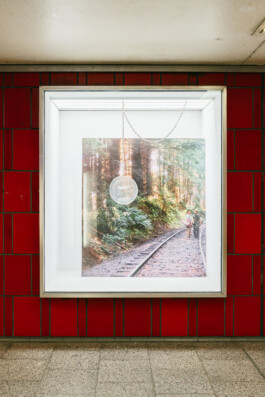
ELMAR: Mein Zugang zu „Stand by Me“ lief zunächst über den Titel, der auch musikalische Assoziationen weckt. Diese Mehrdeutigkeit finde ich interessant, weil sie verschiedene Bedeutungsebenen gleichzeitig öffnet. Inhaltlich spielt das Thema wie Freundschaft eine zentrale Rolle: Bitte bleib bei mir hier unten in dieser dunklen Passage! Es gibt in diesen Geschichten oft eine unterschwellige Bedrohung, insbesondere im Kontext von Kindheit und Jugend. Diese Spannung und auch die damit verbundenen Klischees interessieren mich sehr und tauchen in meinen Arbeiten immer wieder auf. Der konkrete Ort, in diesem Fall die Unterführung, verstärkt diese Atmosphäre. Es ist ein Raum, der eher gemieden wird und ein gewisses Unbehagen erzeugt. Darüber hinaus arbeite ich mit der Idee, meine eigene Herkunft zu fiktionalisieren. Meine Heimat wird dabei zu einem imaginären Ort, ähnlich wie die wiederkehrenden Schauplätze in den Büchern von Stephen King. So entsteht eine Art gedanklicher Raum, in dem sich bekannte Vorlagen und neue künstlerische Beiträge überlagern.
ICA: Die Ausstellung endet in einer von dir geschaffenen Szenografie. Wie hängen Darlingtonia, die fotografische Arbeit und deine Skulptur zusammen?
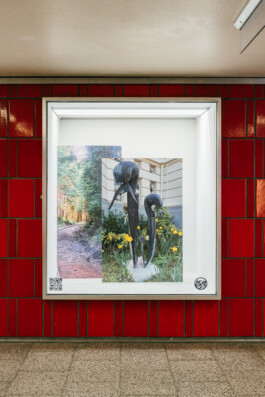
ELMAR: Die Ausstellung funktioniert als ein Miteinander von Bildern, Personen, Erinnerungen und Visionen. Dabei spielen Freundschaft und Wertschätzung eine wichtige Rolle: Ich integriere bewusst Werke von Künstler*innen, die ich schätze, und verstehe das als eine Form von Dialog. In dem spezifischen Setting (einem unwirklichen Ort) interessiert mich, wie sich dennoch eine gewisse Intimität herstellen lässt. “Stand by me!” verfolgt die Idee eines Skulpturenparks in einem ungewohnten Kontext. Daran arbeite ich schon länger in meinem Heimatort Neuwied und die gezeigte “Darlingtonia” der Künstlergruppe Extension funktioniert hier als Modell, als eine Art Ankündigung von dem, was noch kommt.
Meine eigene Skulptur basiert auf den früheren Arbeiten “Mommy” (Kunsthaus NRW 2017) und “Terminator” (Arp Museum 2018), die beide wiederum auf einem filmischen Moment beruhen. Mich interessiert hier besonders der Prozess der Übersetzung: von Film zu Skulptur, von Positiv zu Negativ, von einem Material ins nächste. Durch die Kombination von Glasobjekt und fotografischem Hintergrund entsteht eine Überlagerung verschiedener Ebenen. Diese Verschränkung von Medien und Räumen führt zu einem neuen, eigenständigen Moment; einem Setting, in dem sich Fiktion und Realität begegnen.
--
Stand by Me is an exhibition by Elmar Hermann (*1978) at Island of Contemporary Art in Cologne. As part of the preparations for the show, a dialogue-based exploration presented itself as a natural course of action.
ICA: Your own working method as an artist is characterised by collaborations, ephemeral moments and the blurring of boundaries of authorship. What led you to this approach, and how does it fit with your understanding of art?
ELMAR: For me, art is first and foremost a form of communication. We use images, language and situations to interact with other people. What fascinates me is how diverse this communication can be – it can be humorous, confrontational, unifying or even unsettling. I am particularly interested in the tension between general comprehensibility and specific ‘languages’, for instance within art. At the same time, time plays an important role: how long do we want to engage with a particular statement, an image, etc.? Some works have an impact for only a brief moment, whilst others unfold over a longer period. I feel this ephemeral quality, as well as timing and rhythm, is heightened by the environment of the underpass. My approach to authorship is deliberately open. I frequently work with quotations, images by others or existing works, because I assume that cultural signs are fundamentally available. For me, it is less about ownership and more about exchange. For me, incorporating other perspectives isn’t a curatorial act, but an artistic process – I see exhibitions as encounters or settings in which different figures interact with one another.
ICA: You are very much influenced by film. What role does it play in your understanding of art?
ELMAR: Film, and also TV series, are an important pop-cultural frame of reference for me. Something that many people refer to when we strike up a conversation. This common ground allows us to construct meaning together. At the same time, film is a deeply narrative medium. It offers me the opportunity to integrate narrative structures into my work. When I work with film stills, for instance, associations with sequences and stories immediately arise, which I can incorporate into specific exhibition contexts. I’m particularly interested in the recognisability of such images – that is, the question of how much they form part of a collective visual memory and how narratives can be developed from them using relatively simple means.
ICA: “Stand by Me” is a classic coming-of-age story. What was the key point of reference for you – in terms of content or space?
ELMAR: My initial connection to *Stand by Me* came through the title itself, which also evokes musical associations. I find this ambiguity interesting because it opens up different layers of meaning simultaneously. In terms of content, the theme of friendship plays a central role: Please stay with me here in this dark passage! There is often an underlying sense of threat in these stories, particularly in the context of childhood and adolescence. I am very interested in this tension and the associated clichés, which recur frequently in my work. The specific location – in this case, the underpass – reinforces this atmosphere. It is a space that tends to be avoided and creates a certain unease. Furthermore, I work with the idea of fictionalising my own origins. My home thus becomes an imaginary place, similar to the recurring settings in Stephen King’s books. This creates a kind of conceptual space in which familiar templates and new artistic contributions overlap.
ICA: The exhibition concludes with a scenography you have created. How are Darlingtonia, the photographic work and your sculpture connected?
ELMAR: The exhibition functions as an interplay of images, people, memories and visions. Friendship and mutual appreciation play an important role here: I deliberately include works by artists I admire, and see this as a form of dialogue. In this specific setting (an unreal place), I am interested in how a certain intimacy can nevertheless be created. “Stand by me!” explores the idea of a sculpture park in an unfamiliar context. I have been working on this for some time in my hometown of Neuwied, and the piece “Darlingtonia” by the artist group Extension on display here serves as a model, a kind of preview of what is yet to come. My own sculpture is based on the earlier works “Mommy” (Kunsthaus NRW 2017) and “Terminator” (Arp Museum 2018), both of which in turn are based on a cinematic moment. I am particularly interested here in the process of translation: from film to sculpture, from positive to negative, from one material to the next. The combination of a glass object and a photographic background creates an overlay of different levels. This intertwining of media and spaces leads to a new, independent moment; a setting in which fiction and reality meet.
Elmar Hermann (born 1978, Neuwied) is a visual artist who explores the complexity of human communication in his work. His pieces combine analytical approaches from linguistics and philosophy with narrative elements drawn from film, pop culture and digital culture. This results in ambiguous, humorous works at the intersection of art, theory and everyday life. He studied fine art at the Mainz Academy of Fine Arts (2000–2002) and at the Düsseldorf Academy of Fine Arts (2002–2006), where he was most recently a master student under Prof. Rita McBride. At the same time, he completed a degree in linguistics and philosophy at Heinrich Heine University in Düsseldorf. Hermann frequently incorporates other artistic perspectives into his arrangements and is a member of the artist collective NUANS. Projects, exhibitions and lectures in Germany and abroad, including Kunstverein Düsseldorf, D21 Leipzig, IMC 5533 Istanbul and the Goethe-Institut in St Petersburg. His more recent projects include U RU RU (Fellbach City Gallery, 2025), a contribution to the Fellbach Reflection Trail on the theme of ‘Borders’, and A Natural History of Default Concepts, a web series and repeatedly modified installation that has been appearing since 2020. www.elmarhermann.net
Stand by Me ist eine Ausstellung von Elmar Hermann (*1978) bei Island of Contemporary Art in Köln. Im Rahmen der Vorbereitungen für die Show hat sich eine dialogische Aufarbeitung angeboten.
ICA: Deine eigene Arbeitsweise als Künstler ist durchzogen von Kollaborationen, ephemeren Momenten und dem Verschwimmen von Autorengrenzen. Was hat dich dazu bewogen und wie passt das zu deinem Kunstverständnis?
ELMAR: Für mich ist Kunst in erster Linie eine Form von Kommunikation. Wir nutzen Bilder, Sprache und Situationen, um uns mit anderen Menschen auszutauschen. Dabei fasziniert mich, wie vielfältig diese Kommunikation sein kann – sie kann humorvoll, konflikthaft, verbindend oder auch irritierend sein. Mich interessiert besonders das Spannungsfeld zwischen einer allgemeinen Verständlichkeit und spezifischen „Sprachen“, etwa innerhalb der Kunst. Gleichzeitig spielt Zeit eine wichtige Rolle: Wie lange möchten wir uns mit einer bestimmten Aussage, einem Bild etc auseinandersetzen? Manche Arbeiten wirken nur für einen kurzen Moment, andere entfalten sich über längere Dauer. Dieses Ephemere, ebenso wie Timing und Rhythmus, empfinde ich verstärkt durch das Umfeld der Unterführungl. Mein Umgang mit Autorschaft ist dabei bewusst offen. Ich arbeite häufig mit Zitaten, fremden Bildern oder bestehenden Werken, weil ich davon ausgehe, dass kulturelle Zeichen grundsätzlich verfügbar sind. Es geht mir weniger um Besitz als um Austausch. Die Integration anderer Positionen ist für mich kein kuratorischer Akt, sondern ein künstlerischer Prozess – ich verstehe Ausstellungen als Begegnungen oder Settings, in denen unterschiedliche Figuren miteinander in Beziehung treten.
ICA: Du bist sehr stark von Film geprägt. Welche Rolle spielt er für dein Verständnis von Kunst?
ELMAR: Film oder auch Serien für mich ein wichtiger popkultureller Referenzraum. Etwas, worauf sich viele Menschen beziehen wenn wir ins Gespräch kommen.Dieser Common Ground erlaubt es, gemeinsam Bedeutung herzustellen. Gleichzeitig ist Film ein zutiefst erzählerisches Medium. Er bietet mir die Möglichkeit, narrative Strukturen in meine Arbeit zu integrieren. Wenn ich etwa mit Filmstills arbeite, entstehen sofort Assoziationen von Abfolgen und Geschichten, die ich in konkreten Ausstellungssituationen einbauen kann. Mich interessiert dabei besonders die Wiedererkennbarkeit solcher Bilder – also die Frage, wie sehr sie Teil eines kollektiven visuellen Gedächtnisses sind und wie sich daraus mit relativ einfachen Mitteln Erzählungen entwickeln lassen.
ICA: „Stand by me“ ist ein Klassiker der Coming-of-Age-Geschichte. Was war für dich der entscheidende Bezugspunkt – inhaltlich oder räumlich?
ELMAR: Mein Zugang zu „Stand by Me“ lief zunächst über den Titel, der auch musikalische Assoziationen weckt. Diese Mehrdeutigkeit finde ich interessant, weil sie verschiedene Bedeutungsebenen gleichzeitig öffnet. Inhaltlich spielt das Thema wie Freundschaft eine zentrale Rolle: Bitte bleib bei mir hier unten in dieser dunklen Passage! Es gibt in diesen Geschichten oft eine unterschwellige Bedrohung, insbesondere im Kontext von Kindheit und Jugend. Diese Spannung und auch die damit verbundenen Klischees interessieren mich sehr und tauchen in meinen Arbeiten immer wieder auf. Der konkrete Ort, in diesem Fall die Unterführung, verstärkt diese Atmosphäre. Es ist ein Raum, der eher gemieden wird und ein gewisses Unbehagen erzeugt. Darüber hinaus arbeite ich mit der Idee, meine eigene Herkunft zu fiktionalisieren. Meine Heimat wird dabei zu einem imaginären Ort, ähnlich wie die wiederkehrenden Schauplätze in den Büchern von Stephen King. So entsteht eine Art gedanklicher Raum, in dem sich bekannte Vorlagen und neue künstlerische Beiträge überlagern.
ICA: Die Ausstellung endet in einer von dir geschaffenen Szenografie. Wie hängen Darlingtonia, die fotografische Arbeit und deine Skulptur zusammen?
ELMAR: Die Ausstellung funktioniert als ein Miteinander von Bildern, Personen, Erinnerungen und Visionen. Dabei spielen Freundschaft und Wertschätzung eine wichtige Rolle: Ich integriere bewusst Werke von Künstler*innen, die ich schätze, und verstehe das als eine Form von Dialog. In dem spezifischen Setting (einem unwirklichen Ort) interessiert mich, wie sich dennoch eine gewisse Intimität herstellen lässt. “Stand by me!” verfolgt die Idee eines Skulpturenparks in einem ungewohnten Kontext. Daran arbeite ich schon länger in meinem Heimatort Neuwied und die gezeigte “Darlingtonia” der Künstlergruppe Extension funktioniert hier als Modell, als eine Art Ankündigung von dem, was noch kommt.
Meine eigene Skulptur basiert auf den früheren Arbeiten “Mommy” (Kunsthaus NRW 2017) und “Terminator” (Arp Museum 2018), die beide wiederum auf einem filmischen Moment beruhen. Mich interessiert hier besonders der Prozess der Übersetzung: von Film zu Skulptur, von Positiv zu Negativ, von einem Material ins nächste. Durch die Kombination von Glasobjekt und fotografischem Hintergrund entsteht eine Überlagerung verschiedener Ebenen. Diese Verschränkung von Medien und Räumen führt zu einem neuen, eigenständigen Moment; einem Setting, in dem sich Fiktion und Realität begegnen.
--
Stand by Me is an exhibition by Elmar Hermann (*1978) at Island of Contemporary Art in Cologne. As part of the preparations for the show, a dialogue-based exploration presented itself as a natural course of action.
ICA: Your own working method as an artist is characterised by collaborations, ephemeral moments and the blurring of boundaries of authorship. What led you to this approach, and how does it fit with your understanding of art?
ELMAR: For me, art is first and foremost a form of communication. We use images, language and situations to interact with other people. What fascinates me is how diverse this communication can be – it can be humorous, confrontational, unifying or even unsettling. I am particularly interested in the tension between general comprehensibility and specific ‘languages’, for instance within art. At the same time, time plays an important role: how long do we want to engage with a particular statement, an image, etc.? Some works have an impact for only a brief moment, whilst others unfold over a longer period. I feel this ephemeral quality, as well as timing and rhythm, is heightened by the environment of the underpass. My approach to authorship is deliberately open. I frequently work with quotations, images by others or existing works, because I assume that cultural signs are fundamentally available. For me, it is less about ownership and more about exchange. For me, incorporating other perspectives isn’t a curatorial act, but an artistic process – I see exhibitions as encounters or settings in which different figures interact with one another.
ICA: You are very much influenced by film. What role does it play in your understanding of art?
ELMAR: Film, and also TV series, are an important pop-cultural frame of reference for me. Something that many people refer to when we strike up a conversation. This common ground allows us to construct meaning together. At the same time, film is a deeply narrative medium. It offers me the opportunity to integrate narrative structures into my work. When I work with film stills, for instance, associations with sequences and stories immediately arise, which I can incorporate into specific exhibition contexts. I’m particularly interested in the recognisability of such images – that is, the question of how much they form part of a collective visual memory and how narratives can be developed from them using relatively simple means.
ICA: “Stand by Me” is a classic coming-of-age story. What was the key point of reference for you – in terms of content or space?
ELMAR: My initial connection to *Stand by Me* came through the title itself, which also evokes musical associations. I find this ambiguity interesting because it opens up different layers of meaning simultaneously. In terms of content, the theme of friendship plays a central role: Please stay with me here in this dark passage! There is often an underlying sense of threat in these stories, particularly in the context of childhood and adolescence. I am very interested in this tension and the associated clichés, which recur frequently in my work. The specific location – in this case, the underpass – reinforces this atmosphere. It is a space that tends to be avoided and creates a certain unease. Furthermore, I work with the idea of fictionalising my own origins. My home thus becomes an imaginary place, similar to the recurring settings in Stephen King’s books. This creates a kind of conceptual space in which familiar templates and new artistic contributions overlap.
ICA: The exhibition concludes with a scenography you have created. How are Darlingtonia, the photographic work and your sculpture connected?
ELMAR: The exhibition functions as an interplay of images, people, memories and visions. Friendship and mutual appreciation play an important role here: I deliberately include works by artists I admire, and see this as a form of dialogue. In this specific setting (an unreal place), I am interested in how a certain intimacy can nevertheless be created. “Stand by me!” explores the idea of a sculpture park in an unfamiliar context. I have been working on this for some time in my hometown of Neuwied, and the piece “Darlingtonia” by the artist group Extension on display here serves as a model, a kind of preview of what is yet to come. My own sculpture is based on the earlier works “Mommy” (Kunsthaus NRW 2017) and “Terminator” (Arp Museum 2018), both of which in turn are based on a cinematic moment. I am particularly interested here in the process of translation: from film to sculpture, from positive to negative, from one material to the next. The combination of a glass object and a photographic background creates an overlay of different levels. This intertwining of media and spaces leads to a new, independent moment; a setting in which fiction and reality meet.
Elmar Hermann (born 1978, Neuwied) is a visual artist who explores the complexity of human communication in his work. His pieces combine analytical approaches from linguistics and philosophy with narrative elements drawn from film, pop culture and digital culture. This results in ambiguous, humorous works at the intersection of art, theory and everyday life. He studied fine art at the Mainz Academy of Fine Arts (2000–2002) and at the Düsseldorf Academy of Fine Arts (2002–2006), where he was most recently a master student under Prof. Rita McBride. At the same time, he completed a degree in linguistics and philosophy at Heinrich Heine University in Düsseldorf. Hermann frequently incorporates other artistic perspectives into his arrangements and is a member of the artist collective NUANS. Projects, exhibitions and lectures in Germany and abroad, including Kunstverein Düsseldorf, D21 Leipzig, IMC 5533 Istanbul and the Goethe-Institut in St Petersburg. His more recent projects include U RU RU (Fellbach City Gallery, 2025), a contribution to the Fellbach Reflection Trail on the theme of ‘Borders’, and A Natural History of Default Concepts, a web series and repeatedly modified installation that has been appearing since 2020. www.elmarhermann.net